

Tooth coloured fillings
Amalgam (Mercury) Free Fillings. If you’re one of the many patients who prefer mercury-free, tooth-coloured fillings, you’ll be happy to know that our Doctors can accommodate your request.
Many people still have silver/metal mercury containing fillings from years past in their mouths. These fillings made up of a combination of metals and are sometimes referred to as mercury alloys. They are not particularly pleasing to the eye, and can also present a health issue for some. By unavoidable ‘undercut’ design required to retain the filling material, the old mercury/metal fillings result in a weaker tooth. As they age the restoration expands putting pressure on the remaining tooth and causing micro fractures. As the old metal fillings lift, bacteria can leech under the filling resulting in further problems.
At the time, metal fillings were the best we had. Technology has allowed for the development of a number of new materials. Porcelain inlays, onlays, crowns and composite resins materials can create fillings that are tooth colored and aesthetically pleasing but they also are more conservative and add strength to the tooth.
We can improve your oral health and your smile by repairing or replacing your natural teeth with amalgam-free materials. Today amalgam-free options are available for all dental procedures. Teeth can be repaired with tooth colored fillings, inlays, onlays, veneers and/or crowns. Every situation is different, schedule an exam and find out what option best suits your needs.
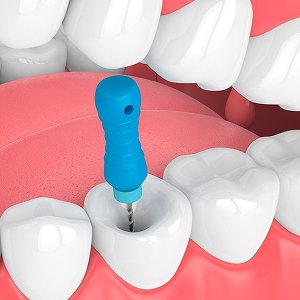
Painless single sitting Root Canal Treatment ( RCT )
Inside each tooth lies a slender strand of ‘pulp’, which contains nerves and blood vessels that provide nutrients to the tooth —that extends down to the tooth’s root. If the pulp becomes infected or injured, the tooth’s nerves die, and often without endodontic treatment, this causes the tooth die as well. When a tooth’s pulp becomes irreversibly inflamed and infected, endodontic treatment (a root canal), is required to prevent the infection from spreading into the tissue. If this happens there will sometimes be facial or gum swelling which can also become very painful if left untreated.
Having a root canal preserves the tooth by removing the infection within the roots and filling the space with a special material. The only other option unfortunately would be to have the tooth extracted.
The procedure is relatively simple, despite what most people believe or have heard. The tooth is numbed (with anesthetic), a small opening is made through the biting surface of the tooth to access the infected material and relieve the pressure caused by the infection. The infected material is then removed and the pulp chamber is sealed. Most of the time, a root canal is a relatively simple one or two visit procedure with little or no discomfort. The length of procedure varies depending on the number of roots and canals the particular tooth has. The treated tooth is then non-vital, which means it is more fragile / brittle than a healthy tooth and a crown/cap is generally recommended to prevent it from fracturing.
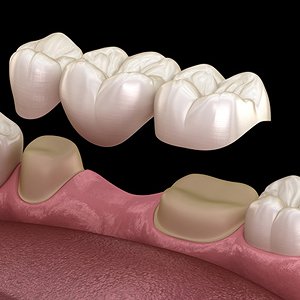
Crown & bridge
As the name suggests, a crown is a cap or covering for a tooth. It is used when your tooth is discoloured, cracked or broken, heavily filled or if fillings have been lost.
When would I need a crown ?
Cover discoloured or worn teeth
If you feel that your teeth are becoming more transparent or becoming darker in
colour, they may be wearing down. Your dentist will discuss the reasons behind this
as it is important that they are addressed first. If your dentist recommends a crown
restoration, then this crown will be fabricated to resemble the natural shape and
strength of your existing tooth through the use of a ceramic material.
Replacement of a large filling
If your teeth are heavily filled, they may be at risk of fractures or de-bonding of
fillings. Frequent replacement of fillings can lead to loss of precious tooth
structure. Repeated dental treatment on the same tooth may lead to deepening of the
filling and subsequent nerve inflammation. To avoid these complications, your
dentist may recommend that a crown is constructed before the filling becomes too
large and remaining tooth structure is too short to support a crown.
To stop a tooth from further cracking or
fracturing
If your tooth is showing fine lines and cracks or you occasionally feel sensitivity
when biting into sticky or hard foods, your tooth may have a deep crack or may be at
risk of complete fracture. This is common for heavily filled teeth, especially where
an amalgam filling is in place. Your dentist may recommend a crown to restore the
tooth and protect its cusps from splitting apart and may suggest replacing any
amalgam with a ceramic restoration.
To anchor a bridge replacing a missing tooth
If a tooth is missing or lost, your dentist will discuss the options for tooth
replacement. This may involve the placement of an implant or tooth supported bridge.
If two or more teeth directly adjacent to the lost or missing tooth are at risk of
fracture or are discoloured and need crowns, a bridge may be a good option to
replace the missing tooth. When the bridge is produced, a porcelain tooth ( pontic )
is fused to the two or more crowns on either side and once the crowns are fitted
onto the adjoining teeth, the porcelain pontic appears to be emerging out of the
gum. A bridge may be a suitable course of treatment for you if you are unable to
have an implant due to issues with your overall health or dental health.
After root canal treatment
Root canal
filled teeth are prone to fractures, due to the nature of root canal treatment and
hollowing out of the tooth in the process. Dentists highly recommend crowning most
root canal filled teeth to protect them from fractures and further bacterial
infections.
Dental Bridge
A dental bridge is a ceramic structure, spanning the gap left by a missing or extracted tooth. A ceramic tooth ( pontic ) is fused between two or more porcelain crowns on either side of the missing tooth that serve as anchors. The anchor teeth are shaped to accommodate the crowns and then a bridge is bonded securely over these teeth. The pontic tooth and the crowns on either side are matched to the colour and the shape of your existing teeth.

Reduced Mouth Opening
Most patient’s mouth opening readily permits access for routine prosthodontic and surgical treatment interventions. Limited mouth opening or microstomia is encountered in patients exposed to sclerodermia, diffuse systemic sclerosis, oro-facial trauma or surgical resections for neoplastic disease, temporo-mandibular disorder (TMD). The latter’s resultant scarring and tissue contracture, together with an accompanying lack of underlying bony support and tissue edema, restricts the mouth opening and renders surgical and dental treatment difficult.
One cannot provide a lower limit for a mouth opening which would prevent from choosing an implant-based rehabilitation. The labial orientation of the implant axis, subsequently compensated by angulated abutments or superstructures, can provide a solution to the access difficulties.
Soft tissue healing and/or scarring can take years to reach a stable status. Meanwhile efforts to achieve a provisional and also definitive tissue support and improve esthetics with a prosthesis must be considered prior to further treatment planning.
Surgical resections or trauma to the oral cavity structures can also lead to loss in vertical dimension, reduced opening of the mandible plus altered mandibular motion. Associated trismus leading to fibrosis and scarring is often the main cause. Radiotherapy can also cause perioral tissue fibrosis. As the treated areas heal, manual mouth opening exercises and stretching may improve the range of mandibular motion and vertical opening. A decreased vertical opening presents with significant challenges for the oral hygiene maintenance, food bolus manipulation and surgical and prosthetic management.
Patients with limited mouth openings are usually readily managed via gentle and scrupulous handling of circum-oral soft tissues and use of smaller sized-instruments as designed for pediatric patients. Dentures with a flexible denture base material can be discussed if this treatment is the best option.
Implant therapy offers possibilities for matching a limited mouth opening with a more convenient and controlled prosthesis access design. Via customized treatment designs retention and stability can be guaranteed. This is also the time to check whether intubation can be safely performed if general anesthesia is planned for the implant-based therapy.
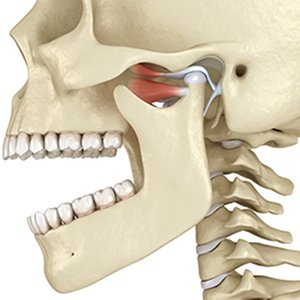
Temporomandibular joint ( TMJ )
Bite correction can be a time consuming and sometimes painful process. Because of this, many adults have learned to live with their alignment problems not having the time or patience for a two year correction program. Many adult patients are still unaware that there is no time limit on correcting misalignment of the bite, mistakenly thinking that correction can only be successful during the youthful growth period.
The advantages of having bite correction are not only aesthetic but more importantly can contribute to long term dental health. Overbite and under bite correction essentially aligns the jaw to create an even bite that does not overly stress any one point of the jaw.
Patients, who have undergone overbite correction and under bite correction report those problems such as TMJ pain and the resulting headaches, have resolved.
Additionally, patients having difficulty performing dental hygiene tasks due to misalignment in the teeth have a higher incidence of tooth decay, gum disease and tooth loss. Orthodontic correction has the dual benefit of enhancing the smile and providing a way to preserve the teeth preventing the need for future expensive dental correction such as dental implants.

Maxillofacial Prosthodontics ( Reconstruction of eyes, nose & ear )
Maxillofacial prosthodontics is a specialty of dentistry which deals with the rehabilitation of patients with acquired and congenital defects of the head and neck region. These range from minor to major functional disabilities combined with cosmetic disfigurement. Maxillofacial prosthodontics is concerned with the prosthodontic management of patients who present with congenital or acquired problems in the maxillofacial region.
Their role involves the fabrication of specialised prosthesis such as maxillary obturators which are specialised removable dentures which plug defects in the upper jaw which are caused by the removal of tumours or are present from birth due to cleft palate. They are also involved in the replacement of missing teeth and facial structures such as eyes, ears and noses.
Maxillofacial prosthodontists will often use osseointegrated implants in order to retain parts of the appliance. Treatment is multidisciplinary, involving oral and maxillofacial surgeons, plastic surgeons, ear, nose and throat surgeons, oncologists, speech therapists, occupational therapists and physiotherapists.
The maxillofacial prosthodontics practice is devoted to habilitate esthetics and function of patients with acquired, congenital and developmental defects of the head and neck. The practice uses dental disciplines to treat, manage, and prosthetically rehabilitate patients whose cancer or cancer therapy has affected their oral-facial structures.