
Dental Implants
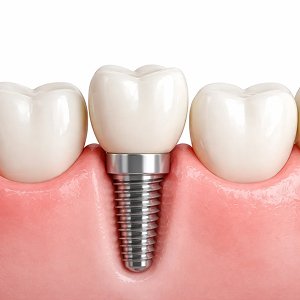
A conventional dental implant is usually known as a “Two Piece” implant which consists of the root component and the tooth component in separate bits. The root component ( implant ) is placed into the jaw bone and to it is connected the tooth component ( abutment ) usually using a tiny screw. The abutment is then prepared or customized to take the final crown. Conventional dental implants are the main type of implants and are an extremely effective long-term solution for missing teeth.
The procedure:
In total 2 trips are needed over about 4-6 months. The first trip usually requires about 3-5 days and the second trip usually requires about a full week. This type of implants are performed less frequently in most modern dental clinics as the amount of time needed to complete treatment is the greatest.
This is how they are done
Step 1: Extraction of the tooth is performed and the implant is placed all in one visit. Sometimes artificial powdered bone material is placed into the empty extraction site to ensure there is enough bone to support the implant. This is called a minor bone graft or a socket graft. If there is not enough bone in the upper jaw molar or premolar implant to be placed bone material is placed in the extraction site and the sinus membrane moved upwards. This is called a sinus lift. In most cases extractions, placement of implants and a socket graft or sinus lift can be done in one appointment. If major bone grafts ( block grafts ) are required it can entail an extra trip before the implants can be placed. This can be determined by looking at a panoramic x-ray or CT scan. After the implant is screwed into the jaw bone the gums are then sealed over the implant. It then takes about 3-6 months for the implant to osseointegrate with your jaw bone before it is stable enough to support the abutment and crown. The implant placement can take place in just one appointment but an initial consultation and diagnosis visit follow up for suture removal and post operative check-up visits are also required.
Step 2: After the implants are stable you would return to have the abutment and crown fitted. During this visit the gums are opened up the abutments are attached to the implants and then impressions are taken of the abutments and surrounding teeth in order to send off the dental laboratory where the crowns are crafted. It is important that good impression are taken so that when the crowns are fitted they fit properly align and match the bite of your other teeth and have a proper minimal margin at the gum line for best appearance. It takes a few days for the lab to make the crowns and the whole process usually takes about 3 appointments over the course of a full week.
Benefits of conventional dental implants
Conventional implants provide an effective long-term solution for missing teeth restoring function to the mouth and creating a natural attractive smile. The implant tooth will look exactly like a natural tooth and the patient will be able to eat drink and speak without any worry as the root of the tooth is also replaced. Implants are created from titanium and there is no risk of irritation to the gums or interference with neighbouring teeth. Conventional dental implants also prevent bone degeneration which can often occur after tooth loss or when a person wears a denture for a number of years. They also work with many aesthetic materials and thus can provide the highest standard of treatment.
Cost of conventional dental implants
The price of conventional dental implants will be based on the severity of the patient’s case and the results they are aiming to achieve. It also depends on the type of treatment method they would like to go through and where in the mouth the implants are being placed.
Bicortical ( From No teeth to fixed teeth in 3 days )
Product Description
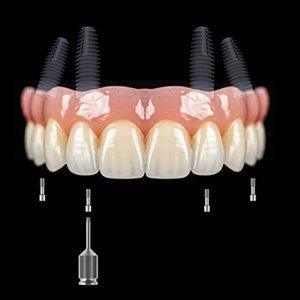
The Bicortical Implant is one-phase and is available with square and round post as well as with ball post. It is available in four different diameters and different insertion depths. The three post versions and the variety of diameters and insertion depths enable a selection of the optimal implant from the Bicortical System for each implant surgery and prosthetics indication. A detailed instruction manual is provided in each package to ensure safe insertion and handling. Adhesive labels for the implant passport or patient record are also enclosed. These contain the implant. From a biomechanical point of view the permanent stabilization of the endosseous artefacts should benefit from the compact support structure situated on the external surface of human bones. The mandible and the maxilla are no exception. The central spongy bone tissue has less retention and stabilizing capabilities and it is formed by few trabeculae, poorly mineralized, immersed in abundant medullar spaces.
Healing is fast, with few painful side effects, and no areas of bone resorption. The two notches carved on each thread ensure that the screw will be blocked and cannot be removed after healing.
Elimination of the tappers, permitted by the unique screw morphology, ensures exact positioning of the screw even when the threads are temporarily externalized as they go through a superficial area of very thin bone, given that further progression of the screw will house them properly in a wider and deeper bone area. The operating technique is worth discussing.
Removal & Implant supported fixed Dentures
What is it ?
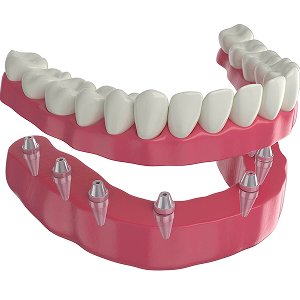
An implant-supported denture is a type of overdenture that is supported by and attached to implants. A regular denture rests on the gums, and is not supported by implants.
An implant-supported denture is used when a person doesn't have any teeth in the jaw, but has enough bone in the jaw to support implants. An implant-supported denture has special attachments that snap onto attachments on the implants. Implant-supported dentures usually are made for the lower jaw because regular dentures tend to be less stable there. Usually, a regular denture made to fit an upper jaw is quite stable on its own and doesn't need the extra support offered by implants. However, you can receive an implant-supported denture in either the upper or lower jaw.
You should remove an implant-supported denture daily to clean the denture and gum area. Just as with regular dentures, you should not sleep with the implant-supported dentures at night. Some people prefer to have fixed (permanent) crown and bridgework in their mouths that can't be removed. Your dentist will consider your particular needs and preferences when suggesting fixed or removable options.
How Does It Work ?
There are two types of implant-supported dentures: bar-retained and ball-retained. In both cases, the denture will be made of an acrylic base that will look like gums. Porcelain or acrylic teeth that look like natural teeth are attached to the base. Both types of dentures need at least two implants for support. Bar-retained dentures — A thin metal bar that follows the curve of your jaw is attached to two to five implants that have been placed in your jawbone. Clips or other types of attachments are fitted to the bar, the denture or both. The denture fits over the bar and is securely clipped into place by the attachments.
Ball-retained dentures (stud-attachment dentures) — Each implant in the jawbone holds a metal attachment that fits into another attachment on the denture. In most cases, the attachments on the implants are ball-shaped ("male" attachments), and they fit into sockets ("female" attachments) on the denture. In some cases, the denture holds the male attachments and the implants hold the female ones.
The Implant Process
The implants usually are placed in the jawbone at the front of your mouth because there tends to be more bone in the front of the jaw than in the back. This usually is true even if teeth have been missing for some time. Once you lose teeth, you begin to lose bone in the area. Also, the front jaw doesn't have many nerves or other structures that could interfere with the placement of implants.
The time frame to complete the implant depends on many factors. The shortest time frame is about five months in the lower jaw and seven months in the upper jaw. This includes surgeries and the placement of the denture. However, the process can last a year or more, especially if you need bone grafting or other preliminary procedures.
Two surgeries usually are needed. The first one places the implants in the jawbone under your gums. The second surgery exposes the tops of the implants. The second procedure comes three to six months after the first.
A one-stage procedure is now used sometimes. In this procedure, your dentist can place the implants and the supporting bar in one step. The success rate of this procedure is high.